Many, many moons ago, my father John Vickerstaff worked as an electrician at St Edward’s Hospital in Cheddleton. An old Asylum with the most gigantic dance hall and stage you could imagine.
Each year around Christmas time the staff would put on a ‘show’ for the patients, other staff and general public. They were variety shows of the kind you would see on the TV at the time. Live from the London Palladium and so on. Comprising musicians, dancers, singers, choirs, barber’s shop quartets and as my father once described, “anyone who could bang two spoons together.”
These shows were very popular and were extremely well supported by the hospital staff and paying public.
In 1984 though, my dad became a little more hands on with the production, wearing the co-producer’s hat along with hospital colleague Peter Dodds, having previously looked after the lighting and technical stuff. This time, rather than put on another variety show the decision was made to ‘have a go at a pantomime.’
It was felt that a full-on pantomime would be a little much to begin with, mostly I think because no one really fancied learning loads of lines! Instead a compromise was found. Samuel French, the publishers had a number of one-act pantomimes which were written entirely in rhyme. Only around an hour in length, with dialogue much easier to learn.
Dad consciously steered away from what he called ‘regular pantomimes’ and always gravitated towards the more unusual or off-the-wall ones. So for St Edward’s Hospital’s first foray into the world of rhyming panto, they chose to put on, ‘Allova Din & His Wonderful Gamp.’
A parody of Aladdin, as you could probably guess!
My mum took a major role in this show along with many family friends and staff at the hospital. Hospital legend Johnny Brough took the villains role which he did several more times over the coming years, becoming one of the best panto villains around.
I video recorded the final performance on our portable VHS recorder and Sony colour video camera. I was ten years old.
Allova Din was an enormous success! As soon as the final curtain came down my dad was asked, ‘what are we doing next year John?’
And so began a run of Pantomimes at the hospital, helmed by my dad.
From memory…
Allova Din,
Cinderalfred,
Humpty Dumpty,
Santa In Space,
Little Miss Muffet and
Goldilocks and The Three Bears.
I’ve started transfer these old tape recordings to my PC before the VHS cassettes fall apart completely. I’ve uploaded Allova Din to Odysee and the link to view it is below.
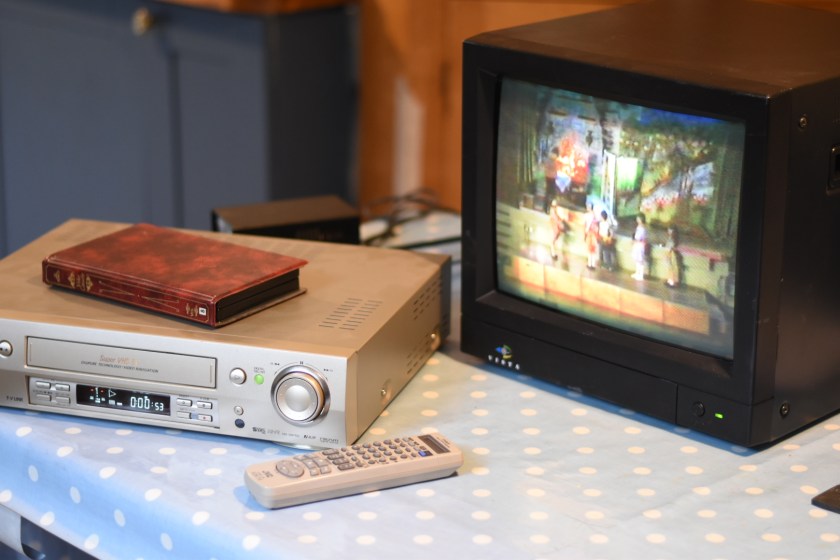
Recently I’ve had an old S-VHS Video Recorder cleaned and serviced by local TV and Hi-Fi shop Smith Bainbridge and Wardle here in Leek. The Recorder wasn’t faulty, it did still work but it had not been switched on and operated properly for a number of years and my intention is to use it to transfer some old VHS tapes onto my computer. I didn’t want to risk feeding it an irreplaceable old tape and watch while it chewed it up. So a thorough clean and new drive belts were in order.
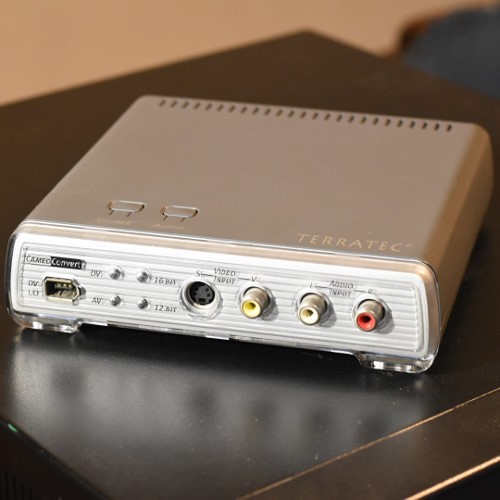
Once the unit was back with me I hooked it up to my PC using a video capture interface. This is a small grey box with connections for the video recorder and a special ‘Firewire’ interface to connect to the PC. This unit converts the analogue picture and audio from the VHS machine and converts it into a digital format which can then be ‘captured’ by the PC and saved to the hard disk as a movie file.
It’s a fairly simple process, but is a little long winded. The video recorder must play back the tape in real time so if a whole tape is to be transferred it can take a few hours. VHS tapes had a run time of typically 2 or 3 hours in Standard Play mode, but some could manage 4. Double that if Long Play was used.
My focus here was a video tape from 1983. It was of the kids from The Mount Methodist Primary School, or West Street School as it was more commonly known in Leek. The year the school closed. This was the final production the school put on. Pinocchio. I was in it in the title role and the show was filmed by my late father John.
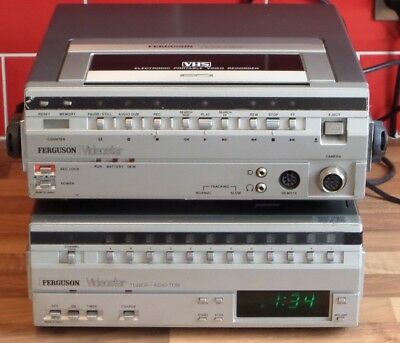
Video recorders were not very prevalent back in 1983. My father had bought one though. He’d opted for a VHS model rather than the more expensive Betamax. He specifically bought a portable model, though portable is probably not how we would describe it today. Ours was a Ferguson Videostar. A video recording system comprising two parts. A television tuner on top of which sat the VHS recorder. With a suitable battery installed in the top unit, it could be removed from the tuner and used as a separate recorder. It was used mostly with a colour video camera.
The colour camera my father chose was a pretty robust model from Sony. In fact there were not very many home user colour video cameras around back then. Almost all the others were black and white. The Sony was an early colour model. The HVC-3000P was a shoulder camera which was the standard format back then. Colour cameras were large beasts and were camera’s only; that is, they didn’t have recording capability. The camera needed to be connected to a separate recorder. Eventually the two units would be combined and the Camcorder would arrive. But not yet. The Sony was intended to be hooked up to a portable Betamax recorder but with the correct cable adapter we used it with our VHS model instead.
The VHS recorder is sadly long gone, but I do still have the Sony camera in full working order.
I still have some sound equipment which will only work on Windows 7, so I still have a computer running it. This is also my video capture computer. It has a firewire interface fitted to which my Terratec capture device is connected, the video recorder into that. Windows Movie Maker captures the video and once stored on Hard Disk, can be edited just like any other digital video.
It has been a considerable number of years since I have watched this recording and I had forgotten how much trouble my parents went to, to make the video look a little special for the kids. Right at the beginning they added a title sequence. I remember dad made a mirror ball for it. If memory serves it was the float from a toilet with small pieces of mirror cemented all over the surface. The ball was connected to a small electric motor which turned it very slowly. Suspended behind the mirror ball was a small white sheet, as a background. In front of the mirror ball was a small pane of glass. The black text that appears during the focus pull was stick on to the glass. The old rub-down lettering, Lettraset it might have been called? This was all done on the kitchen table in our old house on Picton Street.
Right at the very end of the video my parents added all the cast names from the program as a sort of TV rolling credit. Back then there were no sophisticated computer systems available to do snazzy video effects. The BBC of course began to use the BBC Micro for some text and titling effects, but we didn’t have a BBC Micro at that time. Our home micro then was a Tandy TRS-80. A very much simpler and less powerful micro than the beeb and one which didn’t even have lower case characters. The micro only had CAPITAL LETTERS.
The rolling credits here were done the old fashioned way. A couple of sheets of A4 paper were taped together to make one long sheet. My mother typed up all the names from the program on a typewriter loaded with this long sheet of paper. When done, the camera was set and the page was slowly wound up around a kitchen towel holder we had on the kitchen wall, giving the appearance of scrolling titles. The large THE END was done using the same rub-down lettering as the opening titles.
To keep the video looking as authentic as possible I did the most basic of editing adjustments. Firstly I cut out the small amounts of picture jitter that were present when the video recorder was paused during recording. Right at the beginning, the interval and when the performance ended and again when the titles were added. I also boosted the colour saturation a little and increased the contrast to make the video look a little better on modern day flat screens.
Pinocchio The Movie has been uploaded to Youtube. If you would like to see what 1980’s video technology looked like and what the kids of the 80’s did for school productions, be my guest and take a peek!




 Tim Vickerstaff